

For oral-health brands seeking clinical credibility, a KOL advisory board can be transformative. It provides access to the thinking of the professionals who shape clinical practice, generates evidence-based content that supports commercial positioning, and signals to the broader professional community that your brand is a serious participant in oral-health outcomes, not just a product company.
But too many advisory boards fail. They become expensive dinners with no output, gatherings of impressive names who produce no tangible value, or worse thinly disguised product endorsement exercises that damage the brand’s credibility with the very professionals it is trying to influence.
Having designed and established advisory boards in the dental and oral-health space, I have learned that the difference between a valuable advisory board and a wasteful one comes down to structure, substance, and sustained commitment.
Start with Purpose, Not People
The first mistake most brands make is starting with a list of impressive names. Instead, start with a clear answer to this question: what do I need this advisory board to produce that I cannot produce internally?
Legitimate purposes include: generating clinical insight that informs product development or positioning; creating evidence-based content (white papers, discussion documents, clinical frameworks) that supports professional engagement; providing a structured feedback loop between the brand and the clinical community; and building a network of credible advocates who can speak independently about the oral-health issues your brand addresses.
Illegitimate purposes include: creating a platform for product endorsement disguised as clinical discussion; adding prestigious names to marketing materials; and generating content that is really advertising copy with an academic veneer. Professionals see through these immediately, and the reputational damage is lasting.
Identify the Right KOLs
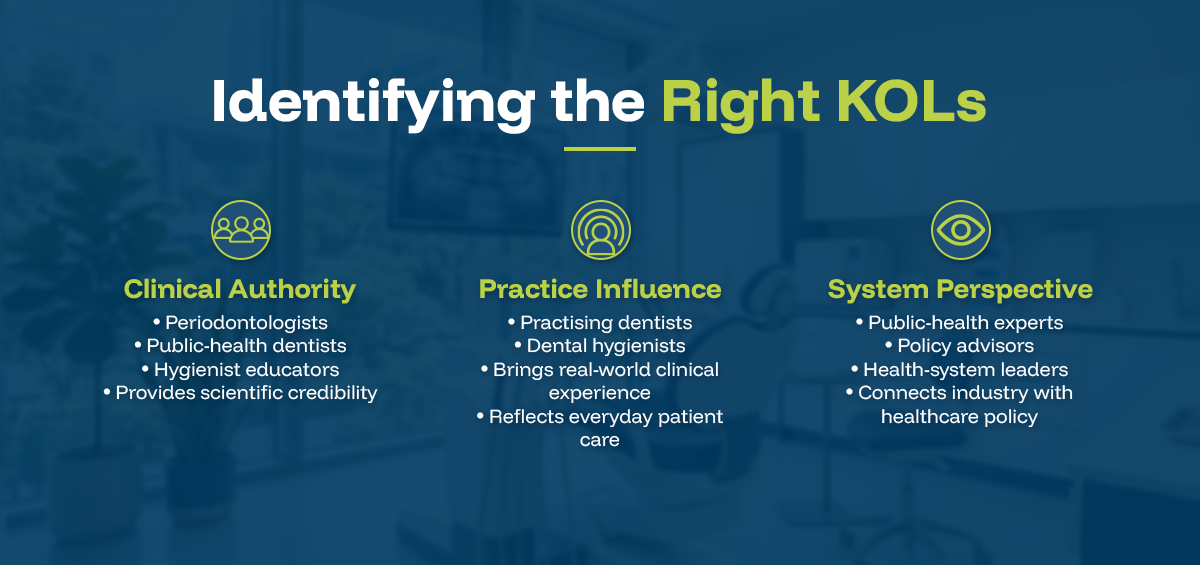
A strong advisory board for an oral-health brand typically includes 8–12 members spanning three dimensions of influence:
Clinical authority. Periodontologists, public-health dentists, and hygienist educators who carry weight in clinical practice and professional education. These members provide the scientific credibility that underpins everything the advisory board produces.
Practice influence. Practising dentists and hygienists who see patients daily and understand the practical realities of chairside recommendation, patient communication, and clinical workflow. They keep the advisory board grounded in what actually happens in practice.
System perspective. Public-health professionals, policy advisors, or health-system leaders who understand the broader context: NHS reform, health inequalities, population-level oral- health data, and the policy environment that shapes what dental professionals can and cannot do. They connect your brand’s work to issues that matter beyond the consulting room.
The balance matters. An advisory board weighted entirely toward academic KOLs will produce intellectually rigorous content that bears no relation to clinical reality. One weighted toward practitioners will lack the gravitas to influence the broader professional community.
Structure the Governance
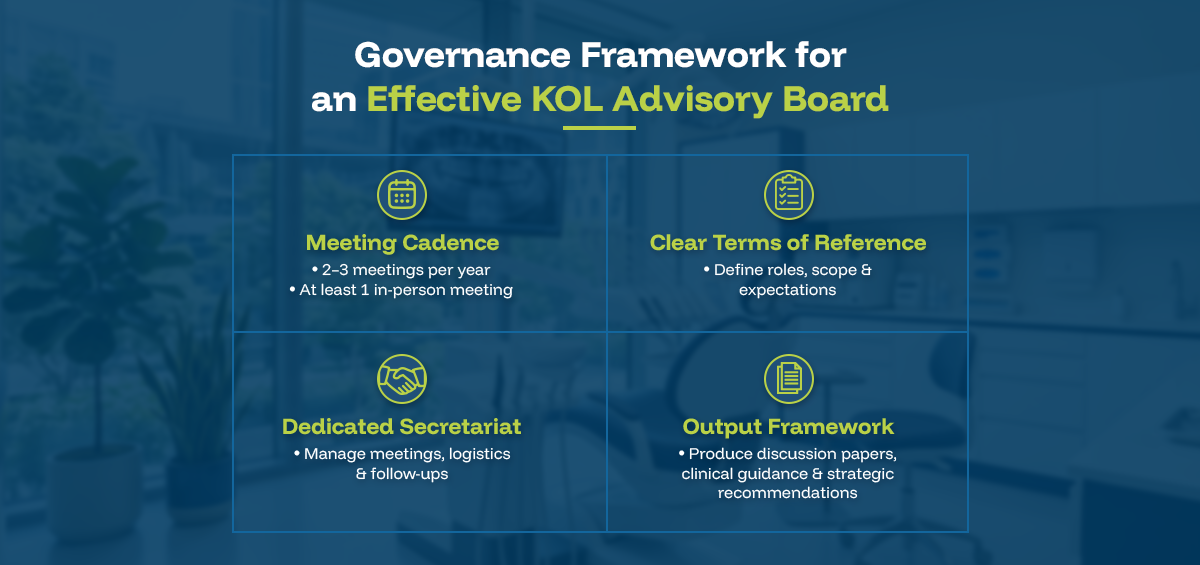
Advisory boards fail when they lack structure. Best practice in healthcare advisory governance suggests establishing clear operational frameworks from the outset. At minimum:
Meeting cadence. Two to three meetings per year is typically right for an oral-health advisory board. Fewer than two and momentum is lost; more than three and members begin to disengage. At least one meeting should be in person.
Clear terms of reference. Define the advisory board’s scope, what it will and will not be asked to do, how outputs will be used, and the expectations on members. This protects both the brand and the advisors.
A secretariat function. Someone needs to own the agenda, prepare materials, manage logistics, capture outputs, and maintain relationships between meetings. This is not an administrative role; it requires someone who understands both the clinical landscape and the brand’s commercial agenda well enough to shape a substantive discussion.
An output framework. Define from the outset what the advisory board will produce: discussion papers, clinical frameworks, position statements, educational content, or strategic recommendations. Without a clear output expectation, meetings become interesting conversations that produce nothing usable.
Lead with Substance, Not Product
The single most important decision you will make about your advisory board is what you put on the agenda. If the first meeting begins with a product presentation, you have already failed. No credible KOL wants to feel they have been recruited to endorse a product.
Instead, lead with a substantive question that the advisory board is uniquely qualified to address. For an oral-health brand, this might be: what can credibly be done to improve oral- health outcomes in a specific population? How should the profession respond to emerging oral-systemic health evidence? What are the barriers to effective prevention at scale, and where can industry play a constructive role?
Commission or author an evidence-based discussion paper that frames the question with data and presents it honestly, including the limitations of what any single brand can achieve. This establishes the intellectual seriousness of the enterprise and gives advisory board members something substantial to engage with.
Your brand’s role in the solution will emerge naturally from a well-framed discussion. You do not need to force it.

Translate Outputs into Commercial Advantage
An advisory board that produces excellent clinical discussion but never connects to commercial strategy is a missed opportunity. The translation happens in three ways:
First, advisory board outputs inform your professional engagement messaging. A discussion paper on oral-systemic health, endorsed by your advisory board, becomes the centrepiece of your field team’s clinical education programme, far more credible than any internally generated content.
Second, advisory board members become natural advocates. A KOL who has contributed to a substantive discussion about oral-health outcomes will speak about those issues at conferences, in publications, and to colleagues. Your brand is associated with the substance, not the sales pitch.
Third, the advisory board provides a structured feedback loop that keeps your brand commercially relevant. Members tell you what clinicians actually care about, what patients are asking, and where the professional community sees unmet need. This intelligence is more valuable than any market research report.
The difference between a valuable advisory board and a wasteful one comes down to structure, substance, and sustained commitment. Lead with a real question, not a product pitch, and the credibility follows.
FAQ
What is a KOL advisory board?
A KOL (Key Opinion Leader) advisory board is a structured group of respected healthcare professionals who provide strategic advice, clinical insights, and evidence-based recommendations to help healthcare and oral health brands improve products, education, professional engagement, and long-term strategy.
Why is a KOL advisory board important for healthcare brands?
A KOL advisory board helps healthcare brands gain clinical credibility, understand practitioner needs, develop evidence-based content, strengthen professional advocacy, and build trust with healthcare professionals while supporting responsible commercial growth.
How many members should a KOL advisory board have?
Most successful healthcare advisory boards include between 8 and 12 members representing clinical experts, practising healthcare professionals, educators, and public health specialists to ensure balanced expertise and practical perspectives.
Who should be included in a KOL advisory board?
An effective KOL advisory board should include:
Clinical specialists
Practising clinicians
Academic researchers
Public health experts
Policy advisors
Healthcare educators
This combination provides scientific credibility, real-world experience, and strategic healthcare insights.
How can KOL advisory boards improve commercial strategy?
KOL advisory boards provide valuable market intelligence, identify unmet clinical needs, improve educational messaging, support product positioning, strengthen stakeholder relationships, and help healthcare brands make evidence-based strategic decisions.