
 Dream Strategies

Dental support organisations are scaling fast. Private equity investment, practice acquisitions, and the consolidation of independent dentistry into multi-site groups have transformed the landscape.DSOs now account for a significant and growing share of dental provision in the UK and Europe.
But many DSOs are growing the business side of dentistry without building the professional engagement infrastructure to sustain it. They invest in property, equipment, and patient acquisition while undervaluing the clinical relationships, professional education, and advocacy systems that drive long-term practice performance.
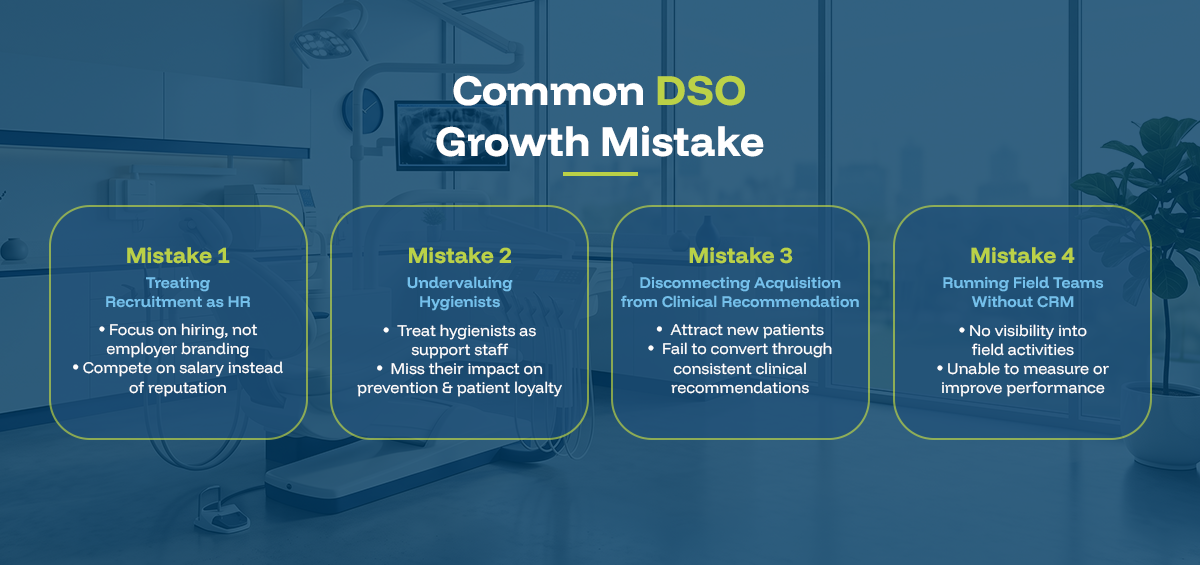
Here are four mistakes I see repeatedly — and what to do about them.
Mistake 1: Treating Dentist Recruitment as HR, Not Brand Strategy
Most DSOs approach dentist recruitment the way any employer approaches hiring: advertise the role, screen candidates, make an offer. This is necessary but deeply insufficient. In a market where associate dentists have choice, the DSO’s ability to attract and retain the best clinicians is a strategic differentiator, not an operational task.
The DSOs that win talent treat recruitment as brand strategy. They invest in their reputation as a place where dentists can develop professionally, access CPD, work with modern equipment, and practise in an environment that values clinical excellence alongside commercial performance. They build relationships with dental schools and hygienist programmes before graduates enter the market. They create alumni networks and professional communities that make leaving feel like a loss.
If your recruitment strategy is a job advert on a dental jobs board, you are competing on salary alone — and you will always lose that competition to someone willing to pay more.
Mistake 2: Undervaluing Hygienist Influence
In many dental practices, the hygienist is the professional who spends the most time with
patients, has the most detailed preventive conversations, and is most likely to recommend specific products or behaviours. Yet in most DSO operating models, hygienists are treated as support staff rather than clinical influencers.
This is a missed opportunity. Hygienists who are empowered, well-trained, and integrated into the practice’s clinical and commercial strategy become powerful drivers of patient loyalty, preventive outcomes, and product recommendation. They influence which toothbrush a patient buys, whether a patient returns for hygiene appointments, and how a patient perceives the practice’s clinical quality.
DSOs that invest in hygienist development — not just clinical skills but communication training, recommendation frameworks, and professional engagement programmes — unlock a commercial lever that most competitors ignore.
Mistake 3: Disconnecting Patient Acquisition from Clinical Recommendation
Most DSOs invest heavily in patient acquisition: digital marketing, Google Ads, social media, local SEO, referral programmes. These generate new patients. But many DSOs pay far less attention to what happens after the patient arrives — specifically, whether the clinical team is equipped and motivated to recommend the treatments, products, and behaviours that drive both health outcomes and practice revenue.
The result is a leaky bucket. Marketing spends to fill the top of the funnel while clinical engagement fails to convert at the bottom. Patients arrive, receive competent treatment, and leave without a clear recommendation for their ongoing care, their home oral-health routine, or the premium services the practice offers.
The fix is to connect patient acquisition to clinical recommendation through a structured engagement pathway: what does every patient hear at their first visit, their hygiene appointment, and their recall? What products are recommended, by whom, and how is that tracked? Patient acquisition without clinical recommendation is half a strategy.
Mistake 4: Running Field Teams Without CRM Visibility
DSOs with multiple sites often deploy regional managers, clinical leads, or field support teams who visit practices to coach, train, and drive performance. But without CRM infrastructure, these visits are untracked, their impact is unmeasured, and there is no way to connect field activity to practice performance.
A field team without CRM is operating on intuition and relationships. This can work at 5 sites. It cannot work at 50. At scale, DSOs need the same visibility into field activity that any well- run commercial organisation takes for granted: what happened at each visit, what was agreed, what followed up, and what changed in practice performance as a result.
This is not about bureaucracy or surveillance. It is about creating a learning system. When you can see which field interventions correlate with performance improvement, you can replicate what works, stop what doesn’t, and build a scalable capability model that grows with the organisation.
The Opportunity
DSOs that get professional engagement right — that invest in clinician development, hygienist empowerment, structured recommendation pathways, and CRM-enabled field management — will outperform those competing purely on location, price, and patient volume. The European dental services market is projected to grow from approximately $126 billion in 2025 to $361 billion by 2035, and the winners will be those that build professional engagement into the core of their operating model.
The brands and DSOs that understand this will define the next era of dental care delivery. The question is whether you are building the infrastructure to be one of them.
DSOs that invest in professional engagement will outperform those competing purely on location, price, and volume. It is what turns a collection of practices into a commercially excellent organisation.
FAQ
What is a Dental Support Organisation (DSO)?
A Dental Support Organisation (DSO) provides non-clinical business and operational support to dental practices, including recruitment, marketing, technology, finance, training and practice management.
What are the biggest mistakes DSOs make when scaling?
The most common mistakes include treating dentist recruitment as a purely HR function, undervaluing hygienist influence, disconnecting patient acquisition from clinical recommendations, and managing field teams without CRM visibility.
How can DSOs improve dentist recruitment and retention?
DSOs can improve recruitment and retention by building a strong professional brand, offering career development and CPD opportunities, investing in modern clinical environments, and creating professional communities that support long-term clinician engagement.
How can hygienists contribute to DSO growth?
Hygienists can influence patient loyalty, preventive care, treatment adherence and product recommendations. With the right training and professional engagement, they can become important contributors to both patient outcomes and practice performance.
Why do DSOs need CRM systems for field team management?
CRM systems help DSOs track practice visits, coaching activities, follow-ups and outcomes. This allows organisations to measure which field interventions improve practice performance and replicate successful strategies across multiple locations